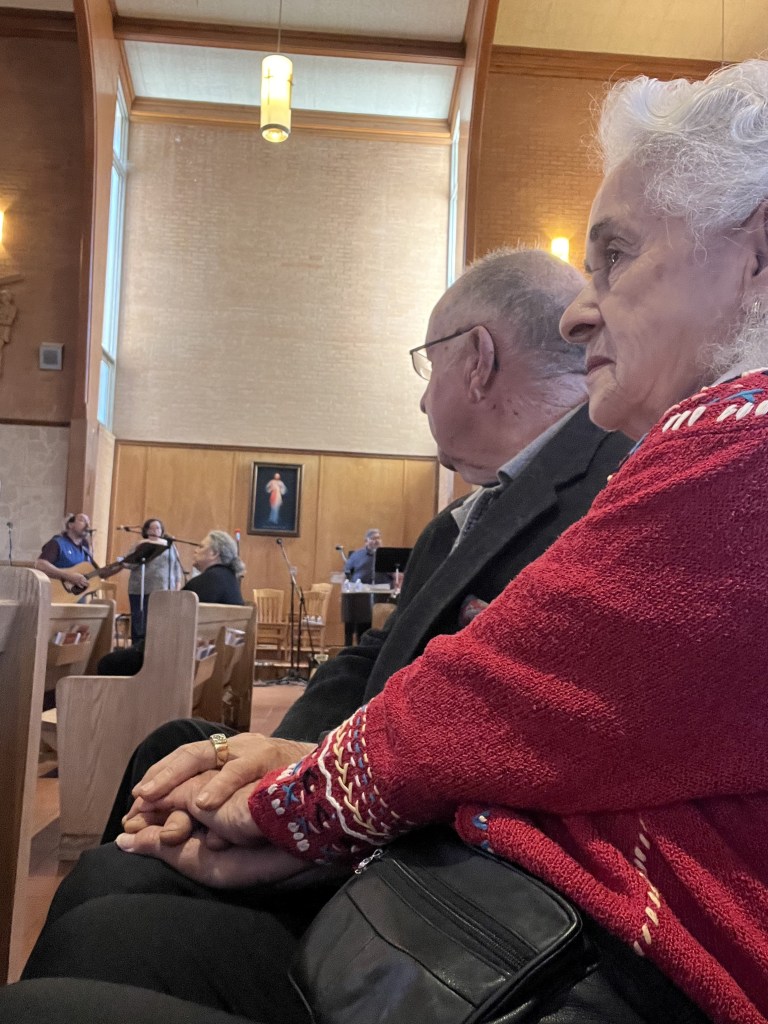
It was “One final announcement” time at the end of mass – that moment when everyone is planning their next move. But the elderly congregation at my childhood church is settled. This is their destination. They arrived 20 minutes early to recite the Rosary and the Memorare. They kneel, sit, and stand gingerly and devoutly, and are settled in the pews where they sit every Saturday evening. Same row, same kneeler, same well-worn pine showing generations of worshippers. My own parents move methodically to “their row” each week, led by muscle memory, devotion, faith.
As the small, joyful woman made her way up to the altar, she was like a bright light in the form of a five-foot nun from the Philippines. She was from the Little Sisters of the Poor.
After a sermon I do not remember (though in the middle of it I did wonder if priests ever use ChatGPT)… we all sat on the edge of our pews, eager to hear what she had to say.
She began with a pun, “Father Nick asked me to keep my speech short…he must not have noticed I’m already short.” The congregation loved her immediately. She went on to tell us about the services the Little Sisters provide. “For nearly 200 years, our order has welcomed the elderly poor and dying into our homes as we would welcome Christ Himself.”
Wow, I thought, sitting next to my elderly parents, what a blessing.
She went on to tell us they have homes where they serve people in over 30 countries and 20 in the U.S.providing personalized care, with sisters living on-site.
With a huge smile on her face, she said, “But to keep things short for Father Nick, I’ll just say, YOU PAY! I PRAY!” Laughter filled the cavernous church. Levity. Something our aging church had not had within the brick walls for years. I feel like even Jesus on the cross gave a little Mona Lisa smile.
Her voice slowed, becoming more measured, “We take turns sitting and praying with the dying.” She said. “As a young nun, I would take my turn and pray. But I was so nervous…” She went on, “My prayer was always: Please don’t die during my shift. Please wait for the next sister’s shift.” She smiled, the congregation laughed, and then told us she finally learned how special and sacred it is to bear witness to someone leaving this world.
She closed by saying in her lively voice, “For those girls who are interested in becoming a Little Sister, we have your veils waiting in the Narthex.” More laughter followed.
What I Learned:
As Sister Maria walked down the aisles with a collection basket, one of the poorest communities in Albuquerque opened their wallets and gave what they could to help. Because that’s what we do – share laughter, share love, share what we have.
“Oh, gosh, do you cry every time you leave?” I asked my sister as she fastened her seatbelt, blinking her watery, tired eyes. “Some days,” she replied, glancing at her phone, ready to make a call on her way home to help someone with something; it didn’t matter who or what—if she said she’d help, she would. I waved goodbye and said a prayer, hoping she’d get a little rest.
I was on. Mom walked outside with a Dove Bar in hand, and in the distance, I heard the rumble of the wood splitter starting. There’s nothing like seeing your legally blind 90-year-old dad operate a motorized, hardened steel blade by himself. I shifted Mom over so I wouldn’t lose focus on either of them. Then Mom suddenly went into nurturing mode and said, “I’ll get you gloves.” Dad and I began splitting wood into smaller, more manageable sizes that he could carry. After the first wheelbarrow full, I didn’t see Mom return, so I said, “Let’s finish tomorrow.” “We still have all of this,” Dad said, sweeping his arm toward the rest of the woodpile, and kept working as if tomorrow depended on it. I looked up briefly and saw Mom approaching, cradling gloves and a hat.
“I can’t believe I found them so fast,” she said proudly, handing them to me like a treasure she discovered only to share with her daughter. I slipped the two right-handed gloves on and secured the bucket hat on my head. “You have to protect yourself when you help Dad with this. Go slowly and don’t rush.” I thought about how Dad rushes as if there’s a wood-splitting deadline he’s barely going to meet, while Mom works methodically, pacing herself like the metronome on the piano—measured, steady, calm. We finished up, and I mentally prepared for Mom’s sundowning—the dreadful circadian rhythm disruption when her confusion becomes overwhelming for all of us.
Before dinner, our dear neighbors stopped by with a plate of freshly made Biscochitos, a small piece of plastic wrap revealing cinnamon-sugar-coated cookies. I thought about how these are the allies we need in our lives. Neighbors like this sweet couple, who built a gate between their home and Mom and Dad’s to make it easier to help, visit, or deliver cookies.
At 1:20 a.m., the sundowning occurred.
“This is not my home. I’d know if I had a daughter. How did I get here?”
I texted my sisters: How do I get Mom to transition from her reality to today?
The three dots on my phone pulsed like a heartbeat: “Try to agree with her and accept as much as possible. Try music and singing, and if she’s up, give her a pancake. Walk her around the house.”
When Mom is in this altered reality, she clocks in at about 3,000 horsepower, a 4-foot-10-inch force.
As the text from my sister rolled in, I felt like she was sending answers to the SAT so I could ace the test: “Food usually calms her down. Try changing the subject or asking her questions like, have you milked a cow…”
There it was. Two pancakes later, and a detailed explanation of how she would spray milk directly into her mouth while milking, Mom was back. “You want fresh milk? THAT’S fresh milk,” she said emphatically.
54 minutes later, and we’re back in bed.
What I learned:
Daughtering is a verb.
The focus toggles between loving and languishing, admiring and administrating, memories and management.
While I need to remember to ensure Mom and Dad are hydrated, medicated, and rested, all must be connected to care and non-operational love.
This Friday, I will be home with my parents. I thought I’d repost a story I wrote a few years ago… the changes they’ve gone through, mentally, physically, and emotionally, over the years are evident. Still, they are eternally guided by faith, hope, love, and my super supportive sisters.
Repost from 2023 Lenten Reflections #4
I am one of four sisters. The youngest and farthest from our parents. Growing up, people would refer to me as “the baby,” and mom would swoop in like an eagle – wings flapping and correct them in her unyielding tone, “Nooooo, she’s the youngest”. At the time, mom was busy raising four independent girls, and the term “baby” was reserved solely for those in diapers, which we were all out of by age two.
As in most families, we each had our textbook roles as siblings: the oldest – reliable and overly cautious (as kids we barely glimpsed at the Grand Canyon as she herded us like a Border Collie away from the edge), the middle sisters – a tad rebellious, with large social circles (probably helped that they had a cool 1957 Ford truck to drive), and me fun-loving and easy-going perhaps a bit lazy. Now that Mom and Dad are 84 and 87, respectively, (AMAZING! I KNOW!) life has changed a bit, and we have adjusted our roles.
That being said, when it came to caring for them as they waltzed hand in hand through their later years, I was not the daughter to step up to the helm and guide the ship. There’s something called “Seagull Syndrome,” where the sibling who lives the farthest away tends to visit, poop on everyone’s ideas about caretaking, and fly home. I try not to do that but rather be the “fun uncle” type daughter who says yes to everything (“Yes, cookies for breakfast counts…yes, we can binge watch Blue Bloods until midnight”) , and then I head home.
Thankfully, with three sisters and the Catholic faith as our north star, one of my sisters retired from her job and moved back home to care for them. With a Master’s Degree in psychology, 30 years of experience managing engineers, and a heart of gold, she was clearly qualified and has made what is possibly the noblest of all jobs look easy. She’s the Helen Keller of caretaking. She knows where mom hurts and how to heal, she knows when dad needs to go for a drive or use the wood splitter, and she knows exactly when they both need a nap. Although they both say they “don’t nap”.
As a bunch (think Brady’s with attitude), we each contribute what we can. My oldest sister is always on call and will drop anything to be present. Outsourcing as needed, and sending Pedialyte, Boost, or whatever is needed via Amazon. My sister, closest to me in age, will jump in and clean, manage all outside work, call daily, and do more between 10 pm and 2 am than most people do all day. We all have our jobs, whether it’s calling to tell them stories of our day, making sure mom takes her medicine, or dad sits down to rest. But my sister, the primary caretaker, has developed a skillful management of herself and our parents, and for that, we are all grateful.
How does she do it?
Always reading and learning, she finds the perfect balance between caretaking and respecting our parents’ need for independence. In the book Being Mortal, author Atul Gawande posits that whether a teen or a senior, they both value autonomy and crave the feeling of purpose and worth every day. So, when Dad, who recently stopped driving, wants to drive the truck from the front yard to the back, we let him buckle up and go…better to help him remember he still can, even if just a little bit.
Equally, when mom wants to give the next-door dog, Ned, leftovers through the fence (even though he’s been fed), she takes care of dear old Ned. I read a story about Bill Thomas, director of a nursing home in NY, who brought in pets for the residents to nurture because he says giving people something to care for makes them more active and alert. Thus, my parents’ surplus of suet, bird seed, dog bones, and corn.
Being part of the “Silent Generation,” our parents are workers. Raised in the Depression Era, everything is recycled, reused, repurposed, and appreciated. Growing up, wood piles were (and still are) precious commodities, prom dresses were made by mom (!), and going out to eat at “The Royal Fork” Buffet was a really big deal.
Luckily, Dad starts each morning by saying, “Another good day, right, Mom?!” Mom replies in her realistic tone, placing her coffee in the microwave again, “Okay, Dad”. They do this, call each other “Mom and Dad,” the titles God bestowed on them that they cherish and will use day after day until there are no more days.
During my visit this past week, I wrote down some notes. As they are specific to my parents, I believe the lessons can be applied to taking care of any senior or otherwise. I wrote this list for my sisters, so it may read like a journal, but I thought it might help someone out there.
I strongly believe “everyone needs a destination.”
Respect what I call “the triangle”: Church, the doctor’s office, and the grocery store. These are their familiar stomping grounds – weave in a few other outings (restaurant, casino, a walk), and it gives the day purpose.
Note: If you have to reschedule a doctor’s appointment, do it. Better to take them when they are prepared and feeling okay than stressed and apprehensive.
Listen to their stories – it connects them to a familiar time
My mom’s stories at the age of 14 are formative years and the spotlight of her daily memory.
When Mom talks about giving up the St. John’s College scholarship offer she received, I think about the huge sacrifice she made for her family by working and supporting them when Grandpa was sick.
Mom will remind you of the way grandma and grandpa warmed water on the stove for their baths and how they sang songs like “When the Moon Comes Over the Mountain” in perfect harmony.
Dad will tell you stories in Spanglish as vividly as if you were there.
Speak loudly
Especially if you are reading a crossword clue to dad or the jumble letters, or driving and mom is in the back seat, or telling a story, or or or…
Diet and meals – let them eat cake!
Mom will eat more and digest better if the food is cut into small pieces.
Gatorade powder (more economical per Dad) is rejuvenating. Stir thoroughly or he’ll tell you there is “perfectly good wasted sugar at the bottom of the glass” and refill it.
Happy Hour is sacred; respect it. Open a beer for Dad and poor Mom’s Pedialyte. Place cheese, gluten-free crackers, and fruit on a plate and enjoy.
The “Big” meal is at 3:00 pm.
Dove Bars – we bought eight boxes at the commissary – it’s a highlight of the day…and a fair bribe to get mom to eat.
Outdoor Activities – Emerson said that the happiest person on earth is the one who learns from nature the lessons of worship. So walk outside a lot.
Mom will always have things to show you around the yard, enjoy the tour. Upon my arrival, she said, “Come meet our new family members.” I went out back and was greeted by 24 cranes who began squawking at me as I approached the fence. “If we go to the poor house,” Mom said, “it’s because Dad and your sister keep feeding these guys so much corn”.
Watching Dad move wood from the ground to the truck to the splitter and stack it is as exhausting as doing it yourself.
Dad will work harder than any 20-year-old you’ve ever met and wonder why “me duele de todo” (everything hurts).
Later, talk Dad through why “todo duele” (everything hurts) and gently remind him he is 87 years old and must pace himself.
Indoor Weather – Dress for summer
It will always be warm inside Mom and Dad’s house. Our brilliant sister has the thermostat programmed to plummet to 72 degrees. (Highly Recommend!) To set the thermostat, press the bottom button on the left once, then walk away nonchalantly. Mom will later turn it up to 81 degrees. Once you are drenched in sweat, repeat the process.
The fireplace will be used if the weather is 70 degrees or below.
Indoor Activities –
Mom thinks her hearing is excellent, but according to a hearing test, it’s not. So, before watching Jeopardy, Mom will ask you to “turn up the volume because Dad can’t hear!”
Mom’s filter has gone from almost there to MIA, so when watching Jeopardy, be ready for a roasting of Ken Jennings, who, according to Mom, “acts like he knows everything” …ummm…he did win about a million times.
With Dad’s macular degeneration, he is still able to enjoy and make out the scenery when watching the Alaska shows. “Good hard workers!” he says. He also loves “Nat Geo”, “The History Channel”, and “The Weather Channel”. The more dramatic, the better with the weather.
Puzzles for mom…have one set up and another on deck at all times. This is her quiet space.
The Newspaper
Holding the newspaper in their hands brings comfort, familiarity, and joy. Even if Dad can’t see enough to read it.
Let Mom read the paper to Dad in the morning while he slurps his way through the coffee and pastries or cookies. Tread lightly, this is their time.
When Dad shakes out the newspaper, he’ll say, “Let’s see who’s left and let’s see who moved out of town.” Then he’ll hand me the obituary section to read aloud “slowly”. I announce the names as if they were crossing the stage at a commencement ceremony, or rather, St. Peter’s gate.
The crossword and Jumble are great mental gymnastic exercises and keep their minds active.
Top 10 Do’s and Don’ts
Don’t do laundry. That’s mom’s gig.
If Dad is struggling with something, DO take over and help.
If mom is struggling with something, leave her alone. She “CAN DO IT!”
Don’t move the scissors, pencils, coffee, Kleenex, or blankets. Life is now done by feel and rote memory.
Do agree more.
Do let Dad cheer up Mom. Dad equals levity.
Do help them remember: Dad may not remember what he ate the night before – i.e., “Oh, we ate enchiladas last night? Did I enjoy them?” “Yes, Dad, you loved them.” “Oh, good!”
OR “Did we watch Blue Bloods last night?” Yes, Dad, you fell asleep in the last five minutes. “Did I enjoy it?” Yes, Dad – you loved it.“Oh, good!”
Do answer the phone mean people prey on the elderly.
Don’t ask them, “Do you remember when…” just retell the story.
What I’ve learned:
Being far away is hard. Wondering if this is the phone call is hard, hard, hard. Saying goodbye to them at the airport when I leave is hard…homesickness in my fifties looks a lot different than it used to, and I mentally prep myself for the lifelong homesickness yet to come.
But I love that God and Grace and Mercy exist. I love that when I cry and truly let out my fear of their absence, the tears feel like a Baptism. I love that I have my sisters. How to care for those who cared for us…I love that we are like a pit crew, repairing what is broken, filling up our parents’ tank with all the love we possibly can because we’re on the clock. I love that we take care of each other.
Thanks for joining me,
Lucretia
On writing…
“You are going to feel like hell if you never write the stuff that is tugging on the sleeves in your heart–your stories, visions, memories, songs: your truth, your version of things, in your voice. That is really all you have to offer us, and it’s why you were born.”
Last week, Cora texted her brothers: “When are you coming home next?”
Friday rolled around, and I heard the rumble of Dexter’s truck in the driveway. He was home for the weekend.
Then, early Saturday morning, Zavier soared through the door, yelling, “What’s up, Fam!”
Cora had asked, and here they were.
It reminded me of when the kids were younger, and Cora would direct the boys in several plays they created. Sometimes she was the police officer, and they were the deputies in a big sting operation, or they were headline performers for a Christmas show. Cora would choose the songs, and the boys followed directions and sang the five holiday songs they almost knew the words to, multiple times. They threw on bonnets for Little House on the Prairie reenactments, performed Baptisms for every doll in the house, and took their bows one show at a time.
Everything went smoothly until it didn’t. Without fail, lyrics would go awry – a dreidel would get mixed into Rudolph’s Reindeer games, the dogs would drink the baptismal water during the doll ceremony, or potty talk would slide its way into a script, the boys laughing hysterically along the way until Cora would shut down the entire show.
But this weekend, they accepted their casting calls and showed up when asked.
Before I knew it, clean laundry was packed up, I wrote them each a little note, and their cars rumbled away. It was a wonderful weekend.
From the Runonmom.com Lenten archives, here’s one of my personal Favorites…thanks for reading.
Today at work, I walked with a first grader to his classroom. The tousled-hair blonde with sweet, aqua eyes looked down at his untied sneakers and uttered, “I still don’t know how to tie my shoes…I mean, I just don’t have time, you know (dramatic pause) now that I play baseball.” He caught my eye to make sure I fully grasped the play ball part. I gave him an understanding, “I KNOOOW, you’ve got a lot to do!” response, and he gave me the kid nod that said, “Finally, someone gets it.”
Clearly, he was a busy guy. Way too busy to mess with shoestrings and all that tying. Baseball was his priority now, and talking about it made him beam. He wanted to share who he was, and by letting me know he was a baseball player, he was pleased with himself and satisfied that I heard it from him first.
We all need our thing
Something that drives us, that makes us jump out of bed and start the day with a spark. Does it define who we are? Maybe. It certainly tells more of our story.
And kids? Kids are constantly exploring. They also need to get out and experience success and failure, whether in an organized sport, class, or just playing with friends on the playground. Pray they seize opportunities to socialize, develop their identities, and discover what they love or don’t.
When I grew up, my sporting perspective was pretty narrow – it was soccer or soccer. As the fourth of four girls, you just follow the pack, and my sister, who is closest in age to me, was a soccer player; therefore, so was I. We had two practices a week, games on Saturdays, reversible uniforms, and our snacks were sliced oranges and water.
Nowadays, there are limitless choices for kids, from soccer to surfing, and mountain biking to martial arts. Practices sometimes end as late as 9:00 pm., and on some nights, dinners are eaten at different times while homework sits on the back burner simmering patiently. Justin and I feel like we are constantly driving somewhere, but we don’t complain because soon enough, the backseat will be empty, garage doors tightly shut, and there will be fewer shoes to trip over.
Naturally, over the years, our kids have dabbled in a lot to find out what makes them tick. In the process, we’ve had: acoustic guitars, bass guitars, ukeleles, soccer cleats, keyboards, lacrosse goals, baking tools, chorus, piano music, gymnastics, basketball high tops, hockey pucks, baseball gloves, frisbee golf goals, shuttlecocks, tennis rackets, catcher’s gear, football helmets, swim goggles, orienteering shoes, toe shoes, tap shoes, ballet shoes, running shoes, metal cleats, turf cleats, unicycles, mountain bikes, skateboards, Ripsticks, bows, arrows, quivers, fishing rods, dart boards, ping pong balls, and more I may have forgotten.
I am so grateful they have WANTED to try so many things, and I am happy we’ve been able to afford them the chance. They’ve settled on (but are not limited to) swimming, baseball, and mountain biking, plus cello, saxophone, and trumpet- a well-rounded crew.
Thank God.
Thank God they found something they care about and enjoy.
I know we’re busy, but as I say, it’s a good busy. It’s a time where we can relish in our children’s successes, see them win, lose, fall, get up, and be there just in case they need us or a Band-Aid.
What I learned:
Let them try. Let them fail. Let them know they have to give it more than a week. Tell them to power through the whole season because there is a team or group depending on them, and life is about teamwork and perseverance.
My first-grade friend, who is simply too busy to bother with tying his shoes, figured out what makes him happy, as all kids should. What a lucky guy.
UPDATE 2025: All of our kids are still playing sports in college and are very happy.
40 Reflections #31: 40 days of raw recollections during the Lenten Season
Tonight is one of those nights when I stare at a blank page. No clue what to write. Guess I should have planned rather than gone organic. Let’s see…
Yesterday, I watched a woodpecker balance upside down in a very acrobatic foraging pose, using its tail feathers like a tripod and clinging effortlessly to peck the heck out of the nuts and seeds we had out. I mean, even this guy went in with a plan, and I’m sitting here with a blank page!
I arrived at the airport this early morning, thankfully with lots of time before my flight, as security was packed. I felt like I won the lottery when my bag did not get flagged, and I could lace up my shoes and head to gate A19.
As I settled in my aisle seat, my window neighbor had arrived. He was an elderly gentleman with only his Sudoku book and a pencil capped with a red eraser marking his last page.
“Sudoku will pass the time”, he said.
He had zero electronic devices to set on airplane mode, no earphones taken from the flight attendant to plug in and watch whatever Delta is offering on the screens dotting the seatbacks. Instead, he stared out the window like we used to, watching luggage load and busy workers shuffle around the tarmac.
We had the loveliest conversation. Turns out he’s a motorhome guy with fascinating stories. Which I will share…soon!
I arrived at my childhood home to help take care of my parents. Mom recognized me (thank you Jesus), and Dad asked if the flight was full as he had my last 1,583 flights prior. Ahhhh…normalcy.
Now, my blank page is full, and so is my heart. More tomorrow.
For me, openly sharing my thoughts in a public forum is weighty. Perhaps it is because I hear my mom’s voice telling me and my sisters, “Be careful what you write down…followed by “and always pay your debts.” The former is what I hear when blogging, and the latter rings in my ears the rest of the day. Respecting Mom’s words, I take heed and trudge forward.
When I began sharing my writing with whomever would read it, I was conscious of the vulnerability clinging to every word. I knew it was a powerful way to connect with others, so I kept writing.
Then, while at my son’s baseball game a few years ago, I thought about this vulnerability and how it plays a sneaky James Bond role in all of our lives.
That sunny day, I sat next to a mom whose son was called up to pitch. As he stepped onto the mound, she turned to the parents in the stands and affirmed in her outside voice, “My son has only pitched ONCE IN HIS LIFE, so I don’t know what’s going to happen!” I assured her we would not judge her or her son. Plus, now we knew he was hers, so we were bound to keep it positive. She continued as most parents would, by hollering, “Just have fun out there, son, and smile!!!” Roughly translated: don’t get hurt, and please, for the love of all that is holy, throw strikes. (Thankfully, there’s an unheralded empathy for parents who watch their child stand in any goal or dig their cleats into the rubber on a pitcher’s mound. Every parent inherently knows to cheer them on (the kids and the parents).
To be honest, when I started blogging, I kind of wanted my mom to also stand up and yell to the world,
“My daughter has only blogged ONCE IN HER LIFE, so I don’t know what is going to happen!”
She didn’t yell it, but she did encourage me to continue writing stories…and to pay off any debts “even if it is only a nickel!”
What I learned:
“Write straight into the emotional center of things.Write toward vulnerability.Risk being unliked.” – Anne Lamott
While walking in Marshalls Store today, I passed by an elderly woman and saw she had a bright pink cherry blossom wreath in her basket.
“What a beautiful wreath!” I told her.
“It is, isn’t it?” She agreed.
I went on to say the wreath would brighten up any space.
“It’s for my daughter’s grave,” she said, wilting a little. “She died one year ago, and since her tombstone hasn’t been placed yet, I thought I would find a way to use this to dress it up.”
“It’s absolutely perfect,” I said. She went on to tell me her husband also died just three weeks shy of their 75th anniversary, at age 100 and 6 months.
“That’s the way life is,” she continued. I leaned in a little, thinking she was about to give me the secret to what life “is,” but instead, she stared at the flowers on the wreath.
I remembered my years in DC, where the cherry blossom trees define spring and renewal. After a few weeks, the delicate petals on the trees float off, symbolizing the impermanence of our fleeting lives.
As our conversation slowed, she said, ” I’m 95 years old.”
“What a blessing!” I said.
“Sometimes I’m not sure if it is or not.” She said, her voice tired.
“So nice talking to you,” I said…and God bless you…The wreath really is — absolutely perfect.”
She smiled, touched my arm, gave it a mom squeeze, and continued pushing her basket toward the clothing section where her caretaker waited.
What I learned:
My five-minute conversation with one kind, elderly woman was priceless to me, as were the connections we made. I pray she will find peace.
I also pray that maybe someone stop in and chat with my parents when they are out and about. They won’t be at Marshalls, but maybe Goodwill, Trader Joe’s, a yard sale, or the Commissary. Sharing a moment with someone and listening to their stories is lubrication for the soul.
CBS News had a story about a girls’ high school basketball coach in Northville, NY this evening. During their last game, the coach who appeared angry at the time, reached out and yanked the ponytail of one of his best players who was visibly sad about their loss. Following this he appeared “to berate her following an emotional loss” at which point another teammate stood up to the coach, in support of the girl.
The school district fired the coach. The regretful coach said he apologized and wished he had those moments to do over again.
I thought about this horrible situation and wondered why we have knee-jerk reactions like the NY coach did, and how we can control our responses. Here are five tips on how to react without a ponytail tug:
Know your triggers – listen to your emotions and know what makes you nuts
Don’t be too judgy – once we make judgments, these become permanent triggers – uh oh
Understand your emotions – know yourself, will you fight, flee, or freeze?
Avoid emotion suppression – this is super unhealthy…embrace your feelings
Make plans NOT TO REACT – be positive and respond with good intentions and respect
What I learned:
As I read further about this NY coach, I discovered his son was also a girls’ basketball coach, the player who defended her teammate was the coach’s great-niece, his wife had died from cancer the previous season, and the reason he started coaching again after his retirement was that his wife thought it would be good to keep him occupied during her illness.
Was he wrong? Yes. Did his emotions dictate his reactions? Yes. Did he regret it? Yes. Have we all been in similar situations? Yes.
Does he get a do-over? Nope.
Did the girl deserve it? ABSOLUTELY NOT.
Emotions are drivers to our reactions. My initial reaction to reading this story was anger which turned to saddness and then compassion. I’ll pray for all of them.
Here’s to Another Good Day, especially since the Pope was released from the hospital.
Lenten Reflections #15 – Motherhood — the moments, the madness, the profound joy, the heart-breaking sorrows
A few years ago, on a Friday night, we went to a local pizza place, sat in our regular booth, chatted, and stared up at the outdated TVs, watching any team play basketball. It was March Madness, and with so many teams playing, the stakes and drama were high—it was truly a basketball binge-watching dream for fans.
That night, I watched the teenage workers pace back and forth delivering pizzas to booths, clearing tables, and refilling their clear cups with colorful flavors at the soda fountain machine. I saw a new employee stop and stare at one of the screens, riveted. I looked up. Wrestling? What? I hadn’t seen wrestling since high school…and on a March Madness night? It turned out it wasn’t just any match, it was the Division 1 Wrestling championships, and Iowa’s three-time national champion, Spencer Lee, was in the depths of competing for a chance at a possible fourth straight title. In the end, however, Lee lost the semi-finals to Matt Ramos from Purdue, cementing one of the most historical upsets in D1 wrestling.
Why did it matter to me? Spencer’s mom…
As notable as the loss, Spencer Lee’s mom was shown reacting to her son’s defeat. As soon as the referee lifted the winner’s arm (which was NOT attached to her son), Lee’s mom tore her glasses off her face and smashed them in her hands, not one, not two, but three times, hurling them to the floor.
Now that’s mad! Mad at the ref? The opponent? Her son?
Or is it passion? Or sadness? Or frustration?
My mind reeled. Sometimes as parents, we are overly invested emotionally and financially in our children’s activities, sports, and school progress. That is to say, wemay fail to recall who is swinging the bat, writing the essay, swimming the mile, and solving the equation. Hint: It’s not us…something I forget quite often. Our (sometimes unreasonable) expectations of what our kids can and should do are crystal clear in our minds: run faster, pitch harder, and study smarter. Easy for us to say.
Is it the “happiness” we want for our kids?
The joy of winning the race or getting into their number one college? I suppose the accomplishment is kinda like a Prime package at our doorstep where underneath the bubble wrap sits all the justification you need for your investment of time, money, and heartache. Of course until the next thing and the next.
Perhaps, as parents, we conflate passion and perfectionism.
Let’s face it, seeking perfection is a fool’s errand. We are all messy and cluttered and muddling through the days. Maybe the lesson here is that sometimes other kids are going to do a lot better than our own kids on the field or in the classroom. Sounds like real life doesn’t it?
I recently read about Esther Wojcicki, author of “How to Raise Successful People”. She is best known as the “Silicon Valley’s godmother” and mom to three very successful daughters: Susan, the former CEO of YouTube, Anne, co-founder and CEO of 23andMe, and Janet, a professor at UC San Francisco. By implementing her parenting philosophy, which Esther refers to as TRICK: trust, respect, independence, collaboration, and kindness, she feels she was able to raise capable, successful children. As far as being a parent, Wojcicki suggests focusing on your behavior. She says, “Parenting gives us perhaps the most profound opportunity to grow as human beings.”
What I learned this week:
Real life is all I know. Real joy, real feelings, real pain. Sundays I sit at church and gaze at the Stations of the Cross on the walls, and I see our own journeys to Calvary. Falling some days, getting up the next. Being carried and lifted, scorned and loved. Some days we need to carry each other on the path. Mr. Rogers’ mother used to tell him in times of tragedy, Grace will always show up in the helpers. Be the helper. Be there for the mom who hurls her glasses, the kid who misses the fly ball, and your own child who needs your presence, not your commentary. Not today anyway.











 runonmom.com