
#15 Lenten Reflections
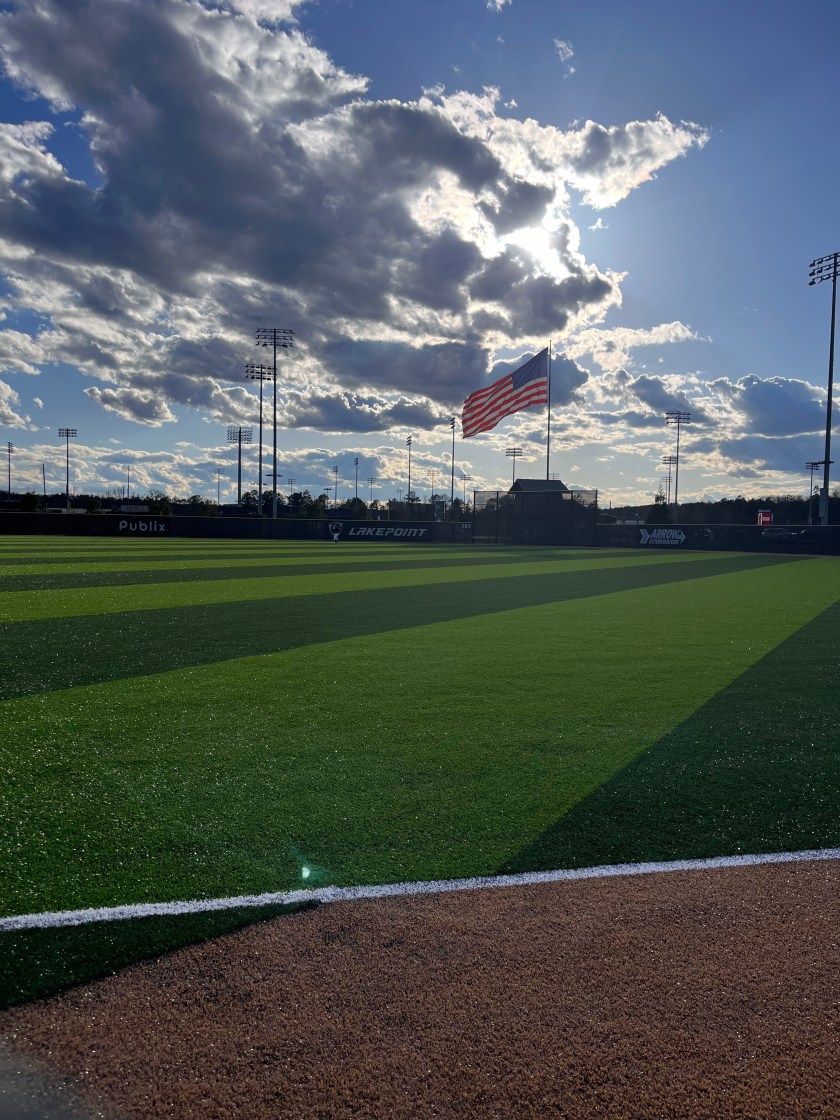
Last week (and tonight) it was a crazy windy day at the Lake Pointe Baseball Complex in Emerson, GA. As I sat watching our son’s games, my hair whipped all over the place. No hair tie. Which is rare for me, like most girls or women with ponytail-ready hair, my wrist dons at least one hair tie. But that morning during class, I had a 4-year-old student who found it comforting and perhaps delicious to suck on the ends of her hair. So I helped put her damp, yet shiny hair in a very high ponytail so she could sing along to our Spanish songs.
Anyway, as I watched pitchers struggle and fly balls change direction like the wind in a sail, I wondered how these gales affected the game. So I did some research and discovered a guy named John Farley, the Chief Technology Officer for Weather Applied Metrics (see this link for an information video). The company measures weather impacts on baseball (and sports in general) using Computational Fluid Dynamics (CFD) modeling, standard trajectory physics, and other meteorological analysis. In short, they study sports and wind.
According to Farley,
“If the wind is blowing hard, that’s the most significant impact. A headwind, combined with a downdraft, can shorten a fly ball hit to the wall by as much as 60 feet. A tailwind, combined with an updraft can lengthen it by as much as 45 feet.”
He went on to say since baseballs absorb moisture from the air “the difference in distance between very dry air and very wet air is roughly 50 feet. That’s because a wet ball is slightly heavier and spongier, so it doesn’t come off the bat as fast. On a hotter day, the air is less dense and so a ball can travel as much as 30 feet farther, compared to a cold day.”
I got kind of lost in the technical jargon, but if I had to play in the wind, I’d prefer a tailwind on a hot day.
Windy at Wrigley Field
I found an example of a windy day at Wrigley Field in Chicago.
Apparently, when the wind is blowing the field is considered a “pitcher’s park”. The better the pitchers, the lower the score. When the wind is blowing out, especially if it is a brisk wind, Wrigley Field becomes a launching pad.
According to The Philidelphia Tale blog, one of the wildest games ever was played in 1979 between the Cubs and the Phillies. The Phillies staked starter Randy Lerch to a seven-run lead in the top of the first inning. He never made it through the bottom of the first. Long fly balls turned into home runs. Short fly balls approached or reached the warning track. Flares flew over the infield and landed well short of outfielders playing near the warning track.
A parade of pitchers from both teams got shelled and watched ERAs soar. The Phillies finally won the game 23–22.
Players take on the wind: Look at the Flag for guidance
Larry Bowa, Phillies shortstop: “I remember the flag was stiff. After I left (Philadelphia) and played there (1982-85), I never saw the flag there ever blow like that. It was nonstop. Usually late in the game, it would stop a little bit.”
Ray Burris, Cubs relief pitcher: “When I would drive into the ballpark on Addison Ave., there was a business that had a United States flag on it. I would always check that flag to see which way that wind was blowing. When it was blowing straight toward the expressway, that was good (for pitchers). That meant the wind was blowing straight in from center field to home plate. Now it was going to take a cannon to get that ball out of there, but if it was blowing toward Lake Michigan, oh my goodness. It was unbelievable. That was just the elements you had to deal with.”
Mike Schmidt, Phillies third baseman: “There were days you played at Wrigley Field you couldn’t even think about a home run, wind would be blowing straight in. You could kill a ball and it would barely make the warning track and it’d have no chance. I’ve seen home run balls get caught at shortstop before. That’s what is unique and fun about Wrigley Field. When you get up in the morning and you’re downtown, you know which way the wind is going to blow from the flags on the buildings.”
What I learned:
It’s been one week since the last windy game and here I sit again on the third base line at Field 9. Rain is coming down, the flag is flying straight out and it’s about 38 degrees. The wind is whipping everything in site, the boys are on the field warming up and you would think it was a sunny day the way they are jogging around and yelling, “We love the cold!” I say a silent prayer that the one thing the wind (and coaches) can’t whip away is Zavier’s confidence.
I couldn’t be more grateful to have a destination. To be lucky enough to come and see my son play his last season of high school baseball. All I can do now is pray he plays, plays well, and when (yes, I said when) he hits the ball, I hope the wind is on his side.
Thanks for joining me, I am so grateful to you all-
❤️Lucretia


 runonmom.com