Let’s start this Holy Week with the words of our dear Pope Leo:
“This is our God: Jesus, King of Peace, who rejects war, whom no one can use to justify war. He does not listen to the prayers of those who wage war, but rejects them, saying: “Even though you make many prayers, I will not listen: your hands are full of blood” (Is 1:15).
In his homily on Sunday, Pope Leo referenced a Bible passage in which Jesus, about to be arrested ahead of his crucifixion, rebuked one of his followers for striking the person arresting him with a sword.
“(Jesus) did not arm himself, or defend himself, or fight any war,” Leo said. “He revealed the gentle face of God, who always rejects violence. Rather than saving himself, he allowed himself to be nailed to the cross.”
What I learned:
These are the words of our Pope. He’s got connections. He’s smart. Listen to him. Steer towards peace. Keep hope and joy alive through prayer for all of those boots that should not be on the ground.
Here is a Prayer for Peace by Pope Francis:
Lord God of peace, hear our prayer!
We have tried so many times and over so many years to resolve our conflicts by our own powers and by the force of our arms. How many moments of hostility and darkness have we experienced; how much blood has been shed; how many lives have been shattered; how many hopes have been buried… But our efforts have been in vain.
Now, Lord, come to our aid! Grant us peace, teach us peace; guide our steps in the way of peace. Open our eyes and our hearts, and give us the courage to say: “Never again war!”; “With war everything is lost”. Instill in our hearts the courage to take concrete steps to achieve peace.
Lord, God of Abraham, God of the Prophets, God of Love, you created us and you call us to live as brothers and sisters. Give us the strength daily to be instruments of peace; enable us to see everyone who crosses our path as our brother or sister. Make us sensitive to the plea of our citizens who entreat us to turn our weapons of war into implements of peace, our trepidation into confident trust, and our quarreling into forgiveness.
Keep alive within us the flame of hope, so that with patience and perseverance we may opt for dialogue and reconciliation. In this way may peace triumph at last, and may the words “division”, “hatred” and “war” be banished from the heart of every man and woman. Lord, defuse the violence of our tongues and our hands. Renew our hearts and minds, so that the word which always brings us together will be “brother”, and our way of life will always be that of: Shalom, Peace, Salaam!
I was walking with bright eyed, Claire today, golden curls falling in her face, cheeks flush from playing outside. We passed by the garden and she picked anything green and gave it a trial taste. “Mmm, mint!” She shrieked. We then both tried a very bitter lettuce and and immediately spit it out, moving on. She ripped a few of the chicory-type lettuce into small pieces and carefully placed them inside the “bowl” of a bright red tulip. It looked like a pricey salad at a steakhouse served inside the delicate petals.
Looking very satisfied with her garden art, she exhaled and said, “Pretty”.
As we walked back to the playground, she passed a small white painted rock with pink swirls on top amid the tulips. “I really like this rock.” She said cradling it like a small kitten. “It’s so pretty”.
“It sure is.” I said hastily trying to keep her moving to our destination.
“Time to go” I said.
“One sec.” she said. I really want this rock.”
“Well…” I told her someone placed it in that special spot and would be back looking for it. “And just in case, we should leave it right where it was.”
With a lot of hesitation, she tiptoed back and she set it in the soil.
Not even five steps away from that small stone and she stopped abruptly.
“Wait!” She looked at me and then up at the sky.
“Señora Lucretia! It was God!”
She quickly walked back to the rock like a long-time friend, picked it up and said,
“God sent this rock down for me and my sister to share! I HAVE to take this rock! It’s the sister rock!!!!”
“God?” I questioned.
“Oh ya, it was God. He wants us to have it. The Claire sisters.”
I jumped in…
“Well, it was probably God, that sent it, but maybe we should leave it here and check on it tomorrow.”
She turned around, rock in hand, and gave it a toss back into the tulip patch.
She walked a little further, running her hand over a patch of reeds.
“Señora, it wasn’t God.” She confessed.
I nodded. “Not God?”
“It was Santa. He left the rock.”
“Santa?”
Riveted, I asked if they knew each other, these two rock delivery guys…God and Santa.
“Yes! God and Santa DO know each other!” She was out of breath from the utter excitement of talking about God and Santa at the same time…something reserved exclusively for December.
“They like to pick leaves together.” She said.
She went on, “But they really like to go fishing together.”
“That sounds nice.” I said.
Our walk continued and we eventually made it to the playground, which to imaginative, joyful and creative minds like Claires, isn’t just a playground, it is a palette for pure magic.
What I learned:
Walk with anyone under five. At their pace. Look high, look low, look outside and most importantly, look inside your heart and listen to their magical words.
It was “One final announcement” time at the end of mass – that moment when everyone is planning their next move. But the elderly congregation at my childhood church is settled. This is their destination. They arrived 20 minutes early to recite the Rosary and the Memorare. They kneel, sit, and stand gingerly and devoutly, and are settled in the pews where they sit every Saturday evening. Same row, same kneeler, same well-worn pine showing generations of worshippers. My own parents move methodically to “their row” each week, led by muscle memory, devotion, faith.
As the small, joyful woman made her way up to the altar, she was like a bright light in the form of a five-foot nun from the Philippines. She was from the Little Sisters of the Poor.
After a sermon I do not remember (though in the middle of it I did wonder if priests ever use ChatGPT)… we all sat on the edge of our pews, eager to hear what she had to say.
She began with a pun, “Father Nick asked me to keep my speech short…he must not have noticed I’m already short.” The congregation loved her immediately. She went on to tell us about the services the Little Sisters provide. “For nearly 200 years, our order has welcomed the elderly poor and dying into our homes as we would welcome Christ Himself.”
Wow, I thought, sitting next to my elderly parents, what a blessing.
She went on to tell us they have homes where they serve people in over 30 countries and 20 in the U.S.providing personalized care, with sisters living on-site.
With a huge smile on her face, she said, “But to keep things short for Father Nick, I’ll just say, YOU PAY! I PRAY!” Laughter filled the cavernous church. Levity. Something our aging church had not had within the brick walls for years. I feel like even Jesus on the cross gave a little Mona Lisa smile.
Her voice slowed, becoming more measured, “We take turns sitting and praying with the dying.” She said. “As a young nun, I would take my turn and pray. But I was so nervous…” She went on, “My prayer was always: Please don’t die during my shift. Please wait for the next sister’s shift.” She smiled, the congregation laughed, and then told us she finally learned how special and sacred it is to bear witness to someone leaving this world.
She closed by saying in her lively voice, “For those girls who are interested in becoming a Little Sister, we have your veils waiting in the Narthex.” More laughter followed.
What I Learned:
As Sister Maria walked down the aisles with a collection basket, one of the poorest communities in Albuquerque opened their wallets and gave what they could to help. Because that’s what we do – share laughter, share love, share what we have.
Today, I will be home with my parents. While I am excited to see them, I am mentally preparing for the changes in them—what will be remembered (their childhood), forgotten (yesterday), or lost (glasses). Will their knees still hurt? Is Dad using the new ramp or still protesting and taking the stairs? Are they dehydrated? Sleeping through the night? Are gluten-free pancakes still the go-to for mom if she’ll eat? Is our legally blind Dad still swinging that axe to chop wood? Can he have more than one beer? And how many Dove bars can Mom have?
I know one thing remains the same—my conversation with mom every day:
“Mom! It’s me, your daughter.” This is what I holler each time I talk to my mom on the phone and every time I see her.
“What?” She’ll ask.
“It’s your daughter, Lucretia,” I say a little louder (the unused hearing aids on the counter are nestled among eyeglass cases and lens wipes, claiming to be the most expensive earplugs Mom owns).
I emphasize the words daughter and Lucretia, and my words come out like a mantra, a prayer that maybe if I say it enough, she’ll open her eyes and exclaim, “Lucretia! There you are!” Like saying the Hail Mary in a Rosary, over and over, in the hope that maybe Mary herself is listening.
Instead, Mom asks, “What number daughter are you?”
“Fourth, Mom, and your favorite,” I say in my sing-song-jokey voice, holding the A in “faaaavorite.” She laughs and says, “Oh! Okay!” It’s not convincing, but I’ll take it.
I’ll record their changes on paper—while my head and heart take time to process and accept them.
What I’ve learned:
Distance can be a blessing and a curse—the heart may grow fonder, but it sure aches in the process.
This Friday, I will be home with my parents. I thought I’d repost a story I wrote a few years ago… the changes they’ve gone through, mentally, physically, and emotionally, over the years are evident. Still, they are eternally guided by faith, hope, love, and my super supportive sisters.
Repost from 2023 Lenten Reflections #4
I am one of four sisters. The youngest and farthest from our parents. Growing up, people would refer to me as “the baby,” and mom would swoop in like an eagle – wings flapping and correct them in her unyielding tone, “Nooooo, she’s the youngest”. At the time, mom was busy raising four independent girls, and the term “baby” was reserved solely for those in diapers, which we were all out of by age two.
As in most families, we each had our textbook roles as siblings: the oldest – reliable and overly cautious (as kids we barely glimpsed at the Grand Canyon as she herded us like a Border Collie away from the edge), the middle sisters – a tad rebellious, with large social circles (probably helped that they had a cool 1957 Ford truck to drive), and me fun-loving and easy-going perhaps a bit lazy. Now that Mom and Dad are 84 and 87, respectively, (AMAZING! I KNOW!) life has changed a bit, and we have adjusted our roles.
That being said, when it came to caring for them as they waltzed hand in hand through their later years, I was not the daughter to step up to the helm and guide the ship. There’s something called “Seagull Syndrome,” where the sibling who lives the farthest away tends to visit, poop on everyone’s ideas about caretaking, and fly home. I try not to do that but rather be the “fun uncle” type daughter who says yes to everything (“Yes, cookies for breakfast counts…yes, we can binge watch Blue Bloods until midnight”) , and then I head home.
Thankfully, with three sisters and the Catholic faith as our north star, one of my sisters retired from her job and moved back home to care for them. With a Master’s Degree in psychology, 30 years of experience managing engineers, and a heart of gold, she was clearly qualified and has made what is possibly the noblest of all jobs look easy. She’s the Helen Keller of caretaking. She knows where mom hurts and how to heal, she knows when dad needs to go for a drive or use the wood splitter, and she knows exactly when they both need a nap. Although they both say they “don’t nap”.
As a bunch (think Brady’s with attitude), we each contribute what we can. My oldest sister is always on call and will drop anything to be present. Outsourcing as needed, and sending Pedialyte, Boost, or whatever is needed via Amazon. My sister, closest to me in age, will jump in and clean, manage all outside work, call daily, and do more between 10 pm and 2 am than most people do all day. We all have our jobs, whether it’s calling to tell them stories of our day, making sure mom takes her medicine, or dad sits down to rest. But my sister, the primary caretaker, has developed a skillful management of herself and our parents, and for that, we are all grateful.
How does she do it?
Always reading and learning, she finds the perfect balance between caretaking and respecting our parents’ need for independence. In the book Being Mortal, author Atul Gawande posits that whether a teen or a senior, they both value autonomy and crave the feeling of purpose and worth every day. So, when Dad, who recently stopped driving, wants to drive the truck from the front yard to the back, we let him buckle up and go…better to help him remember he still can, even if just a little bit.
Equally, when mom wants to give the next-door dog, Ned, leftovers through the fence (even though he’s been fed), she takes care of dear old Ned. I read a story about Bill Thomas, director of a nursing home in NY, who brought in pets for the residents to nurture because he says giving people something to care for makes them more active and alert. Thus, my parents’ surplus of suet, bird seed, dog bones, and corn.
Being part of the “Silent Generation,” our parents are workers. Raised in the Depression Era, everything is recycled, reused, repurposed, and appreciated. Growing up, wood piles were (and still are) precious commodities, prom dresses were made by mom (!), and going out to eat at “The Royal Fork” Buffet was a really big deal.
Luckily, Dad starts each morning by saying, “Another good day, right, Mom?!” Mom replies in her realistic tone, placing her coffee in the microwave again, “Okay, Dad”. They do this, call each other “Mom and Dad,” the titles God bestowed on them that they cherish and will use day after day until there are no more days.
During my visit this past week, I wrote down some notes. As they are specific to my parents, I believe the lessons can be applied to taking care of any senior or otherwise. I wrote this list for my sisters, so it may read like a journal, but I thought it might help someone out there.
I strongly believe “everyone needs a destination.”
Respect what I call “the triangle”: Church, the doctor’s office, and the grocery store. These are their familiar stomping grounds – weave in a few other outings (restaurant, casino, a walk), and it gives the day purpose.
Note: If you have to reschedule a doctor’s appointment, do it. Better to take them when they are prepared and feeling okay than stressed and apprehensive.
Listen to their stories – it connects them to a familiar time
My mom’s stories at the age of 14 are formative years and the spotlight of her daily memory.
When Mom talks about giving up the St. John’s College scholarship offer she received, I think about the huge sacrifice she made for her family by working and supporting them when Grandpa was sick.
Mom will remind you of the way grandma and grandpa warmed water on the stove for their baths and how they sang songs like “When the Moon Comes Over the Mountain” in perfect harmony.
Dad will tell you stories in Spanglish as vividly as if you were there.
Speak loudly
Especially if you are reading a crossword clue to dad or the jumble letters, or driving and mom is in the back seat, or telling a story, or or or…
Diet and meals – let them eat cake!
Mom will eat more and digest better if the food is cut into small pieces.
Gatorade powder (more economical per Dad) is rejuvenating. Stir thoroughly or he’ll tell you there is “perfectly good wasted sugar at the bottom of the glass” and refill it.
Happy Hour is sacred; respect it. Open a beer for Dad and poor Mom’s Pedialyte. Place cheese, gluten-free crackers, and fruit on a plate and enjoy.
The “Big” meal is at 3:00 pm.
Dove Bars – we bought eight boxes at the commissary – it’s a highlight of the day…and a fair bribe to get mom to eat.
Outdoor Activities – Emerson said that the happiest person on earth is the one who learns from nature the lessons of worship. So walk outside a lot.
Mom will always have things to show you around the yard, enjoy the tour. Upon my arrival, she said, “Come meet our new family members.” I went out back and was greeted by 24 cranes who began squawking at me as I approached the fence. “If we go to the poor house,” Mom said, “it’s because Dad and your sister keep feeding these guys so much corn”.
Watching Dad move wood from the ground to the truck to the splitter and stack it is as exhausting as doing it yourself.
Dad will work harder than any 20-year-old you’ve ever met and wonder why “me duele de todo” (everything hurts).
Later, talk Dad through why “todo duele” (everything hurts) and gently remind him he is 87 years old and must pace himself.
Indoor Weather – Dress for summer
It will always be warm inside Mom and Dad’s house. Our brilliant sister has the thermostat programmed to plummet to 72 degrees. (Highly Recommend!) To set the thermostat, press the bottom button on the left once, then walk away nonchalantly. Mom will later turn it up to 81 degrees. Once you are drenched in sweat, repeat the process.
The fireplace will be used if the weather is 70 degrees or below.
Indoor Activities –
Mom thinks her hearing is excellent, but according to a hearing test, it’s not. So, before watching Jeopardy, Mom will ask you to “turn up the volume because Dad can’t hear!”
Mom’s filter has gone from almost there to MIA, so when watching Jeopardy, be ready for a roasting of Ken Jennings, who, according to Mom, “acts like he knows everything” …ummm…he did win about a million times.
With Dad’s macular degeneration, he is still able to enjoy and make out the scenery when watching the Alaska shows. “Good hard workers!” he says. He also loves “Nat Geo”, “The History Channel”, and “The Weather Channel”. The more dramatic, the better with the weather.
Puzzles for mom…have one set up and another on deck at all times. This is her quiet space.
The Newspaper
Holding the newspaper in their hands brings comfort, familiarity, and joy. Even if Dad can’t see enough to read it.
Let Mom read the paper to Dad in the morning while he slurps his way through the coffee and pastries or cookies. Tread lightly, this is their time.
When Dad shakes out the newspaper, he’ll say, “Let’s see who’s left and let’s see who moved out of town.” Then he’ll hand me the obituary section to read aloud “slowly”. I announce the names as if they were crossing the stage at a commencement ceremony, or rather, St. Peter’s gate.
The crossword and Jumble are great mental gymnastic exercises and keep their minds active.
Top 10 Do’s and Don’ts
Don’t do laundry. That’s mom’s gig.
If Dad is struggling with something, DO take over and help.
If mom is struggling with something, leave her alone. She “CAN DO IT!”
Don’t move the scissors, pencils, coffee, Kleenex, or blankets. Life is now done by feel and rote memory.
Do agree more.
Do let Dad cheer up Mom. Dad equals levity.
Do help them remember: Dad may not remember what he ate the night before – i.e., “Oh, we ate enchiladas last night? Did I enjoy them?” “Yes, Dad, you loved them.” “Oh, good!”
OR “Did we watch Blue Bloods last night?” Yes, Dad, you fell asleep in the last five minutes. “Did I enjoy it?” Yes, Dad – you loved it.“Oh, good!”
Do answer the phone mean people prey on the elderly.
Don’t ask them, “Do you remember when…” just retell the story.
What I’ve learned:
Being far away is hard. Wondering if this is the phone call is hard, hard, hard. Saying goodbye to them at the airport when I leave is hard…homesickness in my fifties looks a lot different than it used to, and I mentally prep myself for the lifelong homesickness yet to come.
But I love that God and Grace and Mercy exist. I love that when I cry and truly let out my fear of their absence, the tears feel like a Baptism. I love that I have my sisters. How to care for those who cared for us…I love that we are like a pit crew, repairing what is broken, filling up our parents’ tank with all the love we possibly can because we’re on the clock. I love that we take care of each other.
Thanks for joining me,
Lucretia
On writing…
“You are going to feel like hell if you never write the stuff that is tugging on the sleeves in your heart–your stories, visions, memories, songs: your truth, your version of things, in your voice. That is really all you have to offer us, and it’s why you were born.”
Today is Ash Wednesday and since February 2018, I have written my Lenten Reflections for 40 days each year.
320 posts.
320 Stories of my family, my fears, my fallacies, and my favorite moments.
This is my Lenten practice.
My Holy habit.
According to Charles Duhigg, author of The Power of Habit, there is a three-step loop to building habits: cue, routine, and reward. For example, my cue (Lent) triggers my brain to go into automatic mode and start the routine. The routine (Writing) is the behavior itself. And the reward (Sharing and Showing up) is what my brain likes and helps it remember the habit loop in the future.
Duhigg goes on to say, “…there’s nothing you can’t do if you get the habits right.” So here I am again, trying to get the habits right. One day at a time.
TODAY’S FACTS:
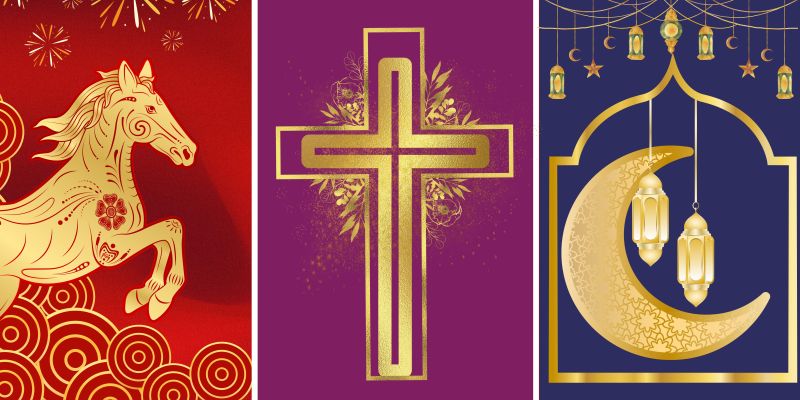
For the first time since 1863, three significant traditions intersect this week: Lent, the Lunar New Year, and Ramadan all begin within less than 24 hours of each other. This rare overlap will not happen again until 2189.
As billions of people across the globe begin their spiritual seasons, it might just be what the world needs…a little more faith in ourselves and our neighbors.
The Lenten Season consists of 40 days of spiritual preparation for Easter, with the three pillars of prayer, fasting, and acts of charity bolstering it up.
Across Asia, the Lunar New Year (the year of the Fire Horse) begins a new cycle with family reunions, food, and traditions.
Ramadan is the ninth month of the Islamic lunar calendar, when Muslims fast from dawn until sunset. Ramadan is supposed to be a month of mercy, goodness, and light that extends to everyone around them, in the hope that everyone receives the ripples of that light.
When interviewed on NPR, Saad Omar, an imam with the Islamic Society of McLean, Virginia, said that the convergence of these religious holidays carries a reminder of our shared humanity. There is a spiritual dimension where two people can have very different ideas and world views and politics, but when they both feel love, the love probably has a similar flavor.
What I learned:
If there is one thing I’ve learned in life, so far, is that we are more alike than we are different. No matter why we pray or fast or give alms, we are all doing it for a reason that is greater than all of us. This is why we are here. To help each other through the murky moments, to feel the hunger for spiritual strength, and to pray that peace will once again be restored.
I awoke this morning with a heartbreaking curiosity about what Mary must have felt the morning of Holy Saturday. There is no record of how Mary spent the day, but I would imagine it was agonizing, silent, exhausting, and empty.
We’ve all been in that void when we wonder why horrible things happen.
Like recently…why were there more school shootings? Why is there a continued war in Ukraine? Why is Putin so evil? Am I supposed to love him like I love my own children? Why are people fighting over land? Why can’t we share? Where is God in all of this when we need him the most? Agonizing moments like this make us feel abandoned by God.
So Holy Saturday, when the most faithful of disciples, Mary, the Holy Mother, who gave her life and all of her love to her son, on that Holy Saturday morning, was severed from the one she loved so dearly.
He talked about what he thought was the impossible, the death of his son, how it came thick and fast. “I sought the intercession of the saints of the church triumphant, evoked all the choirs of angels for the grace of God’s healing, insisted on the impossible, asked for the undoable…”. He felt upended in a tempest, pulled under the surface of everything they knew and were.
Like Mary must have realized, this father said he knew the currents of their lives and their children’s lives would carry them apart. But with faith, they held on tight to each other, then surrendered, finding grace and mercy. “We’ll live it for them and ourselves, doing good, being kind, showing mercy, getting into mischief, finding fun…start the day with prayer, we love, you we miss you, we love you, we miss you…and one day, lead us to the garden where we will never be parted again.”
What I learned:
The despair felt from the loss of someone you cannot live without is strong and unrelenting. Yet the faith we muster serves as a tiny lifeboat in a sea of grief. Let us live like Mary, stand by the cross, knowing in our hearts, the ones we love who have departed first will be waiting on the other side of the tomb in a beautiful garden with arms wide open to receive us.
Today I read the story Rechenka’s Eggs by Patricia Polacco to my kindergarten and first grade classes. My own kids grew up reading Polacco’s family-centered stories, all intermingled with lovely cultural lessons. Rechenka’s Eggs tells a story about Easter eggs intricately painted in the Ukrainian/Eastern European style, a Babushka, and a wild goose. Carefully woven throughout is the message of miracles. Miracles that come when you need them the most, but there’s no reason to expect them.
After I read the story, the children’s hands went up immediately, and we went around the circle discussing what a miracle is to these little ones. With this profound, faith-filled insight, it is hard to believe they only have five or six years on our earth.
What is a miracle?
It is something that makes you really, really happy.
It is when the Jews crossed the sea and the sea parted.
It is when you get hit with a bow and arrow by accident, but you don’t get hurt.
It is something to be happy about.
It is when something happens and you don’t know who did it.
It is a thing that did what cannot exist.
It is when you don’t know what made something happen, and never thought it could.
A miracle is anytime you don’t even wish for something, it just happens.
A miracle is when something bad happens, and then something good happens.
A miracle is when you’re drawing something and you have no art, and then suddenly art appears!
Miracles are the things you are thankful for
A miracle is something you are scared to do, then you try it, and it works
A miracle is something beautiful
A miracle is when you are wanting to win something so much and then you do
A miracle is like good luck
Miracles are impossible for humans to imagine
Who can give me an example of a miracle?
Happy tears
It’s like having something that is plain, but then it is perfectly polished
When the candles lasted for more nights for Hannukah
There was a boy on the Titanic when it crashed, and only women could be saved, and the boy jumped into the sea and he survived, that’s the miracle.
We had a treehouse, and it was rebuilt after being destroyed.
It is Jesus changing the wine and bread
I don’t know if this will happen, but I think it will…it will be a miracle when I grow up and I am big and strong.
A miracle is like when Martin Luther King changed white people fighting with brown people
“Can I do way back then miracles? Then, when Jesus rose, it was a miracle.”
Going to heaven is kinda like that – a miracle
When you invite Jesus into your heart and you get to go to Heaven…but heaven isn’t the only place you go when you die, there’s a really hot place, but I forgot the name of it.
The den full of lions story, when Daniel got out – that’s a miracle
In snow-white, the queen was about to get shot by an arrow and didn’t get hit, that’s a miracle
When Jesus died on the cross, and the guys who helped him (disciples) found out he didn’t die
Last supper when Jesus said one will betray me, and then one did
When baby Jesus was born
When I came alive, it was a miracle
A miracle is something that a human can’t do, but Jesus can
A miracle is when people who couldn’t walk and then they could
Or that time when they ran out of wine and Jesus asked some boys to get buckets of water, and he changed it into wine.
When something bad turns into something amazing
The time in the Bible when there was no food and one kid had a lunchbox, and Jesus kept it filled with the bread and fish
Who has had a miracle happen to them?
A miracle is like if you walk out your front door and there is a pile of clovers, and right on top, above all of them, is a four-leaf clover
I always wanted my lovey, Pinky, to have a rattler inside her, and I woke up one day, and she did.
It’s a miracle my grandma is turning 90 and she doesn’t need a wheelchair, just a stroller (walker)
A miracle happened when I thought my pet catfish had died, and then I found out it didn’t
I almost got hit by a car when I was two, and my aunt pushed me out of the way, and we both survived; that was a miracle.
It was a miracle when I saw a great white sturgeon, the biggest fish in the world, and then it laid its eggs in front of me
It was a miracle cause I didn’t know I was going to Great Wolf Lodge, and then we went
It’s a miracle when something impossible you can’t do and then you can. One time, I didn’t think I could lift a really heavy weight, and then I did.
If you have a pet dog and you release it, and it comes back
It was a miracle when I was sick, I didn’t think I’d feel better, and two days after I did.
Once my aunt couldn’t remember anything, and then she could, that was a miracle
There was a man in the Bible who thought he was going to die, and then he didn’t die, he had so much faith in God that he was swept up in a cloud. That story makes me laugh every time! Imagine a man being swept up by a cloud!
What I learned:
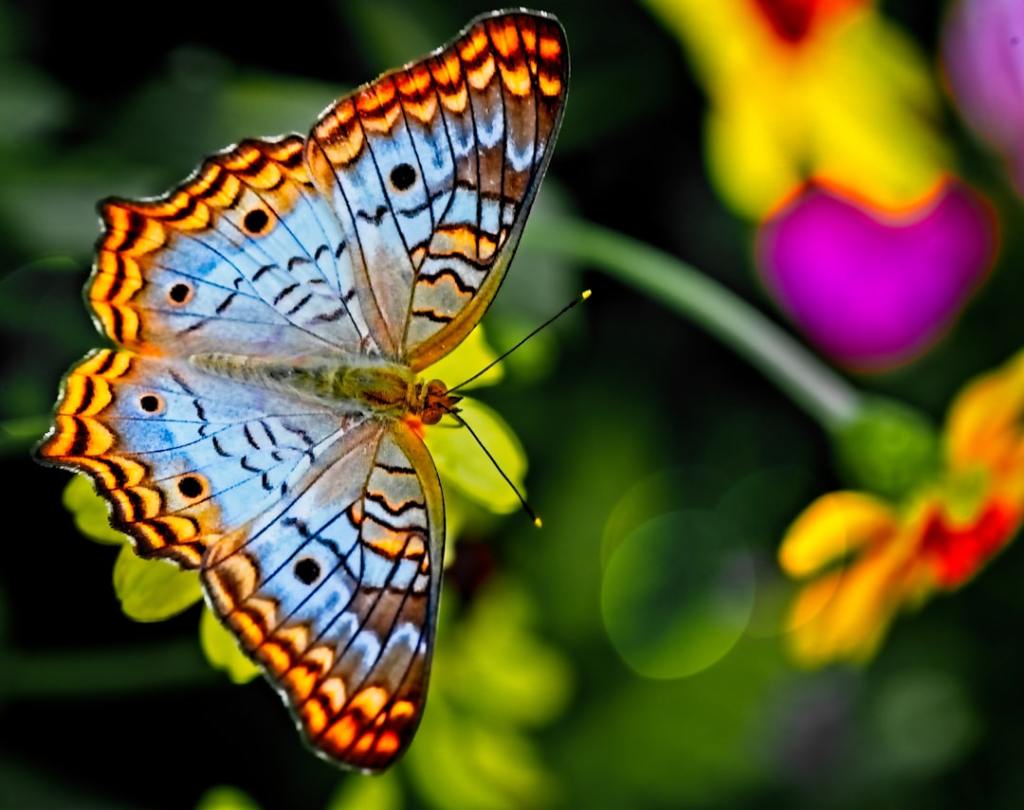
Miracles surround us every day – the sun rising and setting, stones skipping, hummingbirds stopping by for a sip, addictions squelched, children being born, diseases cured, monarch butterflies migrating, stars shining, waves crashing. All miracles.
One of the blessings of miracles is the faith they provide and the hope they restore. That is what happened; each child in class candidly shared their thoughts and filled my heart with love and hope, and courage to believe in miracles.
Albert Einstein said, “There are only two ways to live your life. One is as if nothing is a miracle. The other is as though everything is a miracle.”
As Holy Week begins, I’m reminded of how things have changed over the years. Growing up, Holy Week was a quiet time.
PREP:
Typically, we would have Thursday and Friday off from school and prep the menu for Easter Sunday, including ham, mashed potatoes, red chili (instead of gravy), and the other usual Thanksgiving/Easter suspects. Also, Mom’s pineapple salad made with cream cheese, Cool Whip, and crushed pineapple and topped with shiny maraschino cherries was a Dad-favorite. Aunt Eugenia’s finely chopped salad always made the list too – she was the aunt who rode motorcycles, brought her bird “Bonita” to visit, and played the accordion for Sunday mass. I’ve been told I have the same sharp-slanted nose as her.
HOLY THURSDAY
On Holy Thursday, as we loaded up the station wagon and headed to St. Anne’s, Dad would remind us that mass “would be a long one”. Typically, he would do the readings as a lector, and Mom would play the organ. I had a choice to either turn pages for Mom or try to sit still with my sisters for the two hours of feet washing and the Last Supper. Up the stairs, I climbed to the choir loft for my bird’s eye view.
GOOD FRIDAY
Under the cloudy Good Friday skies, we would attend services at 3:00 pm sharp every year. I still remember the cold, empty altar and solemn sentiment inside St. Anne’s Church. Mom reminded us, “This is the one day we don’t need to genuflect, and we don’t call it a mass. It’s a service.” She went on to explain why, and I said, “Ohhhh,” knowing I really wasn’t paying attention.
But back then, I knew I could ask her anything, anytime I needed to – that time of life when you think your parents are going to live forever and moments stand still like lighthouses shining bright.
HOLY SATURDAY, we buckled in for another “long one,” and I loved that mass. One Easter weekend, after Holy Saturday Mass, we visited my oldest sister at New Mexico State University. That was the year I gave up soda for Lent – even though we never had soda in the house except for Dad’s RC Cola. I remember going out for pizza right after mass and getting the coldest, most delicious Shirley Temple ever. It was served in one of those big red plastic cups with a fat straw. One of my favorite Holy Saturdays on record.
What I learned:
Over the years, my view of Lent became less soda and more sacrifice. In college, a friend of mine and I vowed to say a Rosary together every day. During the long drive to San Diego for spring break, we prayed, after going out with friends we prayed, and even before watching Shamoo jump through hoops, we prayed the Rosary. Yup. I was wild and crazy then, too.
Today, unless kids attend a school starting with the word “Saint,” it’s likely they will be in school during Holy Week. Even Good Friday. Because times are different. Holy Week just seemed holier back then. Calendars are filled with games, practices, and activities, with church fitting into the gaps. Like anything else, age readjusts the lens on what matters.
Lent is about sacrifice and love – giving the homeless water, really listening to a friend, praying for peace in our world, and realizing we all truly need each other.
Every week after church, Dad asks if our church fills up. “It’s pretty full, Dad, but we have fewer churches here in Marietta,” I say every week. In fact, my hometown of Albuquerque has 32 parishes for the 37% of Catholics in the city. Meanwhile, in Marietta, Ga…there is a grand total of 4 Catholic churches to accommodate our 1% of Catholics. I cannot speak to the amount of practicing Catholics, but even for the Christmas-Easter crew, there are plenty of options to kneel and say an Ave or two.
Mom and Dad attend the 4:30 pm mass on Saturday evenings. Arriving late to church is very stressful for Mom, and arriving early to church is unheard of for Dad. I decided to choose my battles today and leave early (for mom) and drive slooooowly to church. Dad, whose driving speed from ages 14-86 could only be described as manic, noted my speed and said with a tinge of disappointment in his voice, “Wow, you really follow the speed limit.”
Cars zoomed past, and as we approached an intersection, we passed a dry, grassy field on fire, uncontained and spreading toward the road. We (Siri) called 911, and the fire department said they were on their way. Mom asked for the time, and I reassured her that we had 30 minutes to complete an 8-minute drive. As the firetruck passed, we finally pulled into a packed parking lot. I carefully (and slowly) squeezed our Honda between a huge SUV and a flashy Impala lowrider with gold rims.
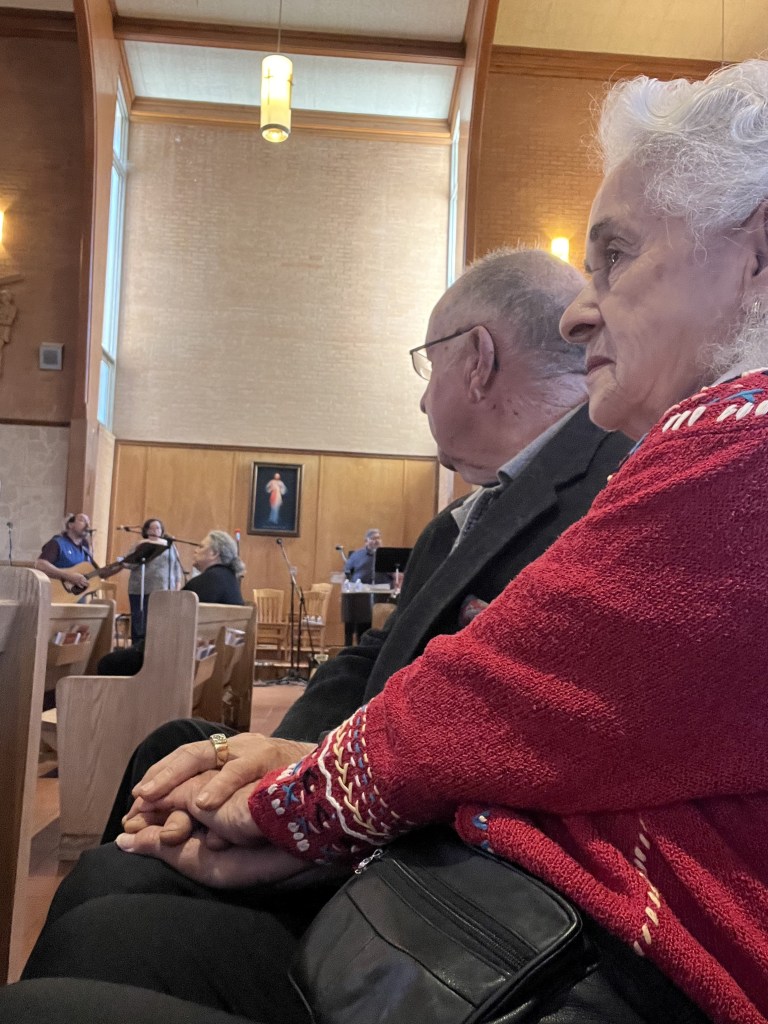
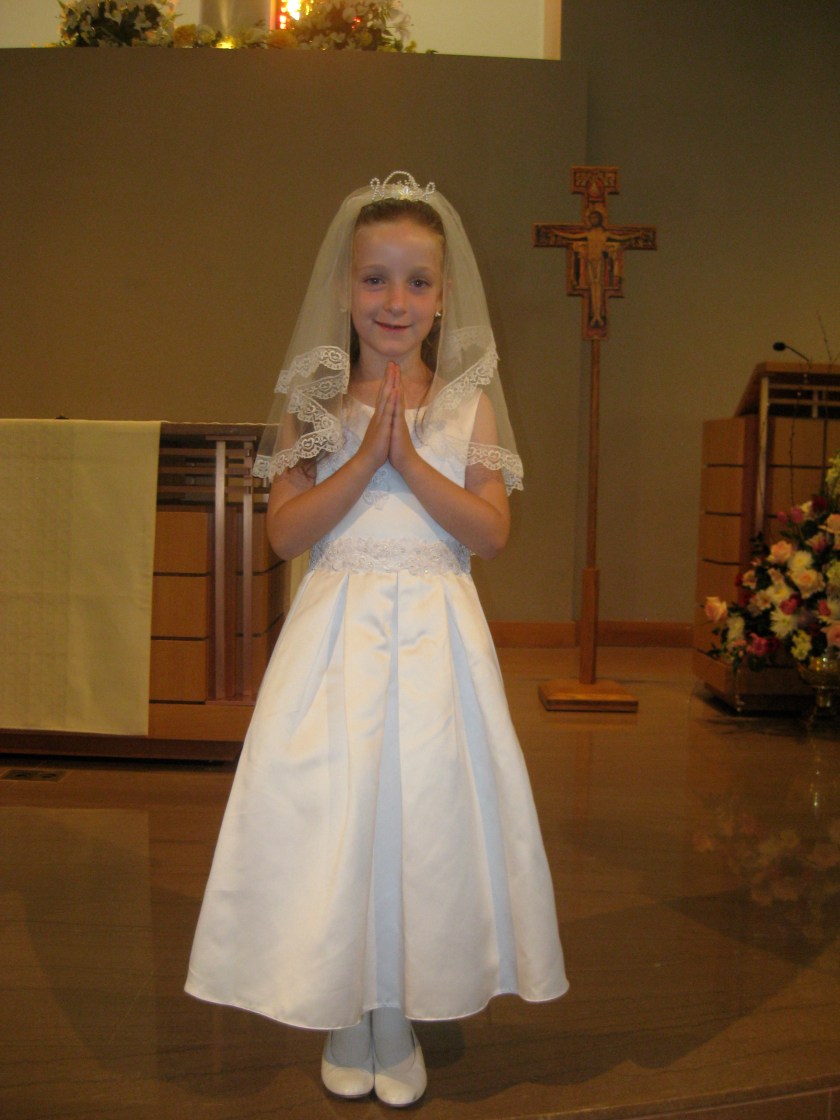
When we opened the door to the Sanctuary, we were surprised to see the pews filling quickly. Not only was it Palm Sunday, but it was also First Communion for 17 kids. Concerned that Mom and Dad would get tired and hungry, I proactively gave Mom a mint, which calmed her, then leaned over and whispered to Dad that I bet God would let us leave early since we showed up for the rosary ahead of mass. Unrattled, they both sat patiently and sang along to the Spanish and English hymns, except when Mom plugged her ears because the guitar was just “too loud”.
First Holy Communion is a family event. This evening, pews were filled with extended families. Palms were craftily folded into crosses, babies were passed from row to row, and children were dressed with care – bows in place, tiny neckties straightened. The communicants all sat in the first two rows with pressed suits and snow-white dresses. Flowers dotted the girls’ hair, and boys stood proudly in their shined shoes. One by one, they walked, leading with their prayer hands as they received their First Holy Communion. Their parents and siblings beamed because it was a big deal. This sacrament truly is tremendous. As Catholics, we know that the Holy Eucharist is the origin of our faith. Pope Francis has called it the “Sacrament of Love”. He says, “The Eucharist is at the heart of ‘Christian initiation’, together with Baptism and Confirmation, and it constitutes the source of the Church’s life itself. From this Sacrament of love, in fact, flows every authentic journey of faith, of communion, and of witness.”
Pope Francis knows what he’s talking about. He’s a big deal.
What I learned:
I reminisced about our church in Marietta. Every Saturday before the final prayer, two elderly men meet the deacon at the foot of the altar, bow their heads, and receive a blessing and a pyx with care. A pyx is a handheld tabernacle that holds the Eucharist to provide spiritual nourishment for the homebound. Each week, I try to envision their situations, marvel at their kindness, and pray for their ongoing strength and hope.
Then I thought of every little lovely wavy-haired child whose dark eyes glistened after receiving the “Sacrament of Love”. I pray that every one of them will encounter extraordinary joy, grace, mercy, thanksgiving and communion on this side of eternity.






 runonmom.com